


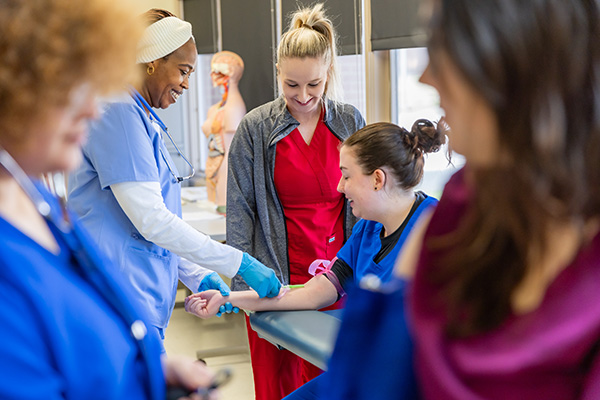
 Prepare for a career in healthcare at Vol State's John B. Wallace Health Sciences Division. Choose from degree and certificate programs in dental assisting, diagnostic medical sonography, EMS and paramedic education, fire science, health information management, medical laboratory technology, ophthalmic technology, physical therapist assisting, radiologic technology, respiratory care, and sleep diagnostics technology — with programs ranging from one semester to two academic years (3 to 24 months).
Admissions Requirements
The number of students admitted to each Health Sciences Career Education Program is limited, and the admission process is competitive. There are usually more applicants than spaces available. The number of applicants admitted to each Health Sciences program is limited by several factors, including the number of clinical training spaces available, the projected number of positions in the health care industry for graduates, and enrollment limitations imposed by accreditation agencies. Admission to each program is based on several factors, including successful completion of the admission requirements and interviews with an admissions committee of professionals in the relevant field.
Those who desire admission into any Health Sciences Degree/Certificate program must:
- Submit the following to the Office of Admissions and Records
- Application to the College meeting admission requirements for the College based on the admission or readmission status the applicant is seeking.
- ACT or SAT scores if under 21 years of age
- All high school transcripts or high school equivalency scores
- Transcripts from other colleges attended
- Appropriate Placement Test results (if applicable)
- Apply to the specific Health Sciences Career after being admitted into the College
- Application deadlines for the Health Sciences programs vary.
- For information about a specific program's application process and deadline, review the applicable Information Packet or contact the program director.
The Health Sciences Degree/Certificate programs are academic programs of study that require completion of certain clinical or practicum experiences to successfully complete the program. The College’s clinical or practicum site partners require students to undergo criminal background checks and drug screens, provide proof of vaccination history, and/or provide other information to participate in clinical or practicum experiences at their sites. Failure to meet the requirements of the College’s clinical or practicum site partners may inhibit successful completion of the clinical or practicum component and prevent completion of the program.
Prospective students must also follow program-specific directions for the desired Health Sciences Degree/Certificate, which may include (but are not limited to):
- Complete a VSCC medical history report
- Document proof of medical insurance
- Complete student background check(s)
- Complete drug screen(s)
- Obtain specific vaccinations/immunizations or medical tests
Criminal Background Check
All students will be required to complete a criminal background check upon formal acceptance into a Health Sciences program. The results of the background check will be forwarded to the administrative staff at Vol State. Please review our Background Check Requirements and the steps to submit your results. More than one background check may be required.
Drug Screening
Students seeking enrollment in the Health Sciences Programs requiring participation in clinical training in area hospitals and related clinics must provide evidence of having passed a 10-panel urine drug screen prior to participating in clinical or practicum experiences. Find out more information about the screening procedures and locations. More than one drug screen may be required.
Vaccinations, Immunizations, and Medical Tests
All students are required to complete and provide documentation for various vaccinations, immunizations, and medical tests to fully participate in clinical or practicum experiences. These may include, but are not limited to, tuberculin (TB) skin tests and vaccinations for Hepatitis B, varicella, influenza, and COVID-19. Refer to the desired program of study for specific details.
Professional Advancement
The Division also offers a variety of professional advancement opportunities beyond degree/certificate programs. These include training in Coding/Reimbursement and Advanced Practitioner in Respiratory Care.
Advising Information
Since the Health Sciences programs do not follow the standard academic calendar, it is recommended that you attend an open advising session or call/email the appropriate program personnel. It is also recommended that you read over the information that is posted for the program(s) that you are applying for.
Time & Financial Requirements
Health Sciences Career programs include coursework in clinical settings, which requires students to be available during clinical hours, often totaling up to 40 hours per week. It is usually not possible to participate in the professional component of most Health Sciences Career programs on a part-time basis. Clinical assignments are during periods appropriate to the professions and may include day, evening, and weekend hours. Expenses related to assigned clinical courses such as medical exams, liability insurance, medical insurance, uniforms, meals, travel, and other items specific to each career area should be expected. All of these expenses are the student's responsibility.
Only students who have been screened and admitted into the programs of study in Health Sciences will be permitted to register for professional-level courses in each discipline.
Programs Accreditation
Many Health Sciences programs are accredited by national, profession-specific accrediting bodies, in addition to the college's institutional accreditation from SACSCOC.
| Program | Accrediting Body |
|---|---|
| Dental Assisting | Commission on Dental Accreditation (CODA), American Dental Association |
| Diagnostic Medical Sonography | Joint Review Committee on Education in Diagnostic Medical Sonography (JRC-DMS) |
| EMS / Paramedic | Commission on Accreditation of Allied Health Education Programs (CAAHEP) |
| Health Information Management | Commission on Accreditation for Health Informatics and Information Management Education (CAHIIM) |
| Medical Laboratory Technology | National Accrediting Agency for Clinical Laboratory Sciences (NAACLS) |
| Ophthalmic Technician | International Council of Accreditation (ICA), formerly the Committee on Accreditation for Ophthalmic Medical Programs |
| Physical Therapist Assistant | Commission on Accreditation in Physical Therapy Education (CAPTE) |
| Radiologic Technology | Joint Review Committee on Education in Radiologic Technology (JRCERT) |
| Respiratory Care | Commission on Accreditation for Respiratory Care (CoARC) |
| Sleep Diagnostics Technology | Committee on Accreditation for Polysomnographic Technologist Education (CoA PSG) |